
A Sikh wedding is an occasion where family, faith, heritage and celebration come together. From the excitement of the preparations at home to the spiritual significance of the Anand Karaj, every part of the experience carries its own atmosphere, emotion and importance.
For couples planning a Sikh wedding in London, choosing a photographer is about finding someone who can appreciate all these elements. It is not simply about beautiful portraits or having someone document the day. It is about finding a photographer who understands the traditions, recognises the significance of individual ceremonies and knows how to capture the moments that matter without interrupting them.
Sikh weddings can be wonderfully varied. Some celebrations take place over several days, with traditional ceremonies involving both families, while others bring everything together into a more contemporary schedule. There may be hundreds of guests, multiple venues, elaborate outfits, traditional music and a packed programme of events.
The challenge for a photographer is to bring all these elements together into one coherent visual story.
So, what should you look for when choosing a Sikh wedding photographer, and what makes photographing an Anand Karaj different from other wedding ceremonies?
Understanding the traditions behind a Sikh wedding
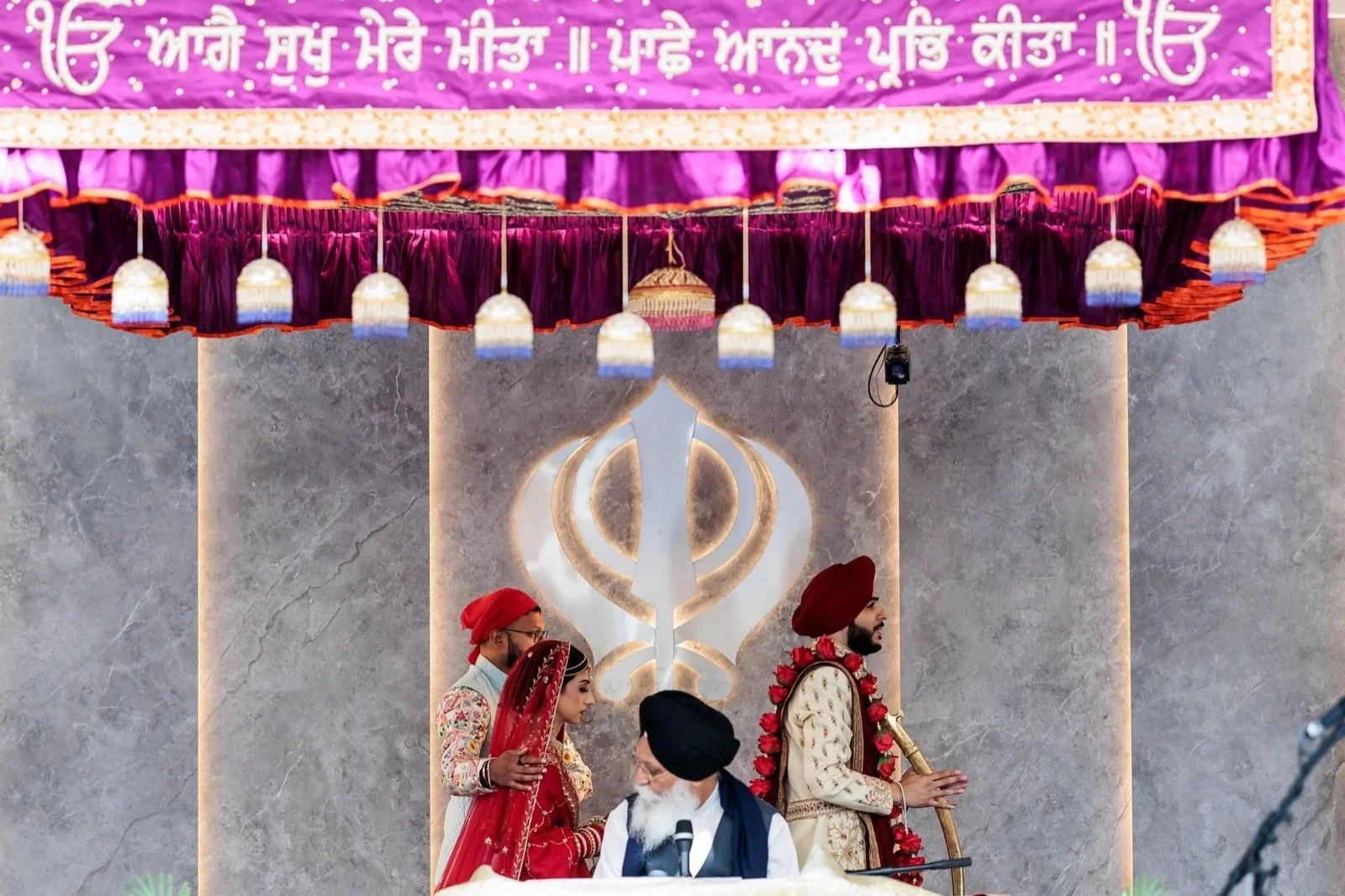
One of the most important considerations when choosing a photographer is their understanding of Sikh wedding traditions.
Although every family celebrates differently, there are recognisable ceremonies and customs that form part of many Sikh and Punjabi weddings. Some are rooted in Sikh religious practice, while others are cultural traditions passed down through generations.
A photographer who understands the distinction will be better prepared to anticipate important moments and appreciate their significance.
Here are some of the ceremonies and traditions worth discussing with your photographer.
Roka and Kurmai – the beginning of the journey
The wedding celebrations often begin long before the actual wedding day.
The Roka marks an agreement between the families and the intention for the couple to marry. It is often an intimate occasion involving close relatives, blessings and the exchange of gifts.
The Kurmai, traditionally associated with the formal engagement, may involve an Ardaas, gifts and the presentation of a ring or other tokens.
These occasions are particularly lovely to photograph because they bring together two families at the beginning of a new chapter. The photographs are often less formal, allowing plenty of opportunities to capture genuine interactions and expressions.
Chunni ceremony – welcoming the bride
The Chunni ceremony is a particularly meaningful occasion in many Punjabi Sikh families.
A chunni, often a beautifully decorated scarf, is placed over the bride's head by members of the groom's family. It symbolises acceptance and the welcoming of the bride into her future family.
From a photography perspective, there are several details worth anticipating: the presentation of the chunni, the bride's reaction, the involvement of close relatives and the exchange of gifts.
These are moments that can easily be overlooked if a photographer is unfamiliar with the ceremony.
Maiyan and Vatna – preparations before the wedding
The Maiyan ceremony is one of the more colourful and expressive pre-wedding traditions.
Family members gather around the bride or groom as a traditional paste, commonly made using turmeric, flour and oil, is applied to the skin. The ceremony is often accompanied by singing, laughter and playful interactions between relatives.
The atmosphere can be wonderfully relaxed, with family members enjoying themselves and taking part in the preparations.
For photographers, it offers an opportunity to capture a very different side of the wedding story. Close-up details, hands applying the Vatna, expressions from parents and grandparents, and the spontaneous moments between siblings all contribute to a collection of photographs that feel personal.
Jaggo – when the celebrations come alive
Few pre-wedding traditions create quite the same atmosphere as Jaggo.
Traditionally associated with the night before the wedding, Jaggo is a lively celebration involving music, dancing and family participation. A decorated vessel, often called a gaggar, is carried as family members sing traditional songs and dance.
The maternal side of the family often plays a prominent role, with the celebrations bringing everyone together.
From a photographer's perspective, Jaggo is about energy and anticipation. The movement of the dancers, colourful outfits, traditional decorations and reactions from the crowd make it a particularly rewarding event to document.
It also presents technical challenges. Lighting can be unpredictable, people are constantly moving and the atmosphere is often energetic. Experience with low-light photography and fast-moving celebrations makes a real difference.
Choora and Kalire – an emotional wedding morning
The wedding morning brings some of the most personal moments of the entire celebration.
The Choora ceremony traditionally involves the bride's maternal uncle, or Mama, presenting her with a set of bangles. These are often red and ivory, although designs and colours vary between families.
The Kalire are decorative ornaments attached to the bride's bangles, traditionally by her sisters, cousins or close friends.
There is often a lovely mixture of excitement and emotion during this ceremony. Parents watch as their daughter prepares for the wedding, while relatives gather around to offer their blessings.
Photographs of the Choora, Kalire, jewellery and bridal preparations become important details within the overall wedding story.
The Anand Karaj: photographing the spiritual heart of the wedding
At the centre of a Sikh wedding is the Anand Karaj, meaning a ceremony of blissful union.
Unlike a conventional civil ceremony, the Anand Karaj takes place in the presence of Sri Guru Granth Sahib Ji, with the couple committing themselves to a shared spiritual journey.
For a wedding photographer, this requires a different approach.
Understanding the order of the ceremony, knowing where to position yourself and appreciating the significance of the proceedings are essential. The photographer should never become a distraction to the couple, the congregation or the religious service.
The Baraat and arrival at the Gurdwara
The wedding morning often begins with the groom's preparations, including the tying of the turban and the Sehra Bandi ceremony.
The Sehra is traditionally placed over the groom's face or turban, depending on family custom, before he sets off for the Gurdwara.
In some families, the groom arrives on a decorated horse, known as a Ghodi, accompanied by music and dancing. In others, a decorated car forms part of the procession.
The Baraat is a wonderful opportunity for energetic documentary photography. The groom's expressions, the celebrations among friends and family, and the excitement surrounding his arrival all contribute to the story.
Milni – two families becoming one
The Milni is the formal meeting between members of the bride's and groom's families.
It is traditionally a warm and welcoming occasion, with corresponding relatives greeting one another. Fathers, grandfathers, uncles and other family members may take part, with garlands, embraces and gifts forming part of the celebrations depending on family custom.
For a photographer, the Milni moves quickly. Knowing which family members are involved and understanding the sequence helps ensure that the important greetings are not missed.
It is also a wonderful opportunity to capture the interaction between two families who are coming together.
Palla ceremony – a symbolic connection
During the Anand Karaj, the Palla ceremony takes place before the Laavan.
A section of the groom's scarf or Palla is placed into the bride's hand, traditionally by her father or another family representative. This symbolises the joining of the couple as they begin their married life together.
It is a subtle but significant moment, often accompanied by the singing of a Shabad.
A photographer familiar with the ceremony will understand the importance of positioning and timing, capturing the connection between the couple and the involvement of their families without disrupting the proceedings.
The four Laavan – understanding the significance
The four Laavan are the central part of the Anand Karaj.
As the four hymns are recited, the bride and groom walk around Sri Guru Granth Sahib Ji, completing four circuits together.
Each Laav represents a stage in the spiritual journey of marriage, exploring the couple's relationship with one another and their connection with the Divine.
These moments cannot be repeated or recreated. They require anticipation, preparation and an understanding of the ceremony.
From a photography perspective, the challenge is to capture the couple's expressions, the movement of the Palla, the details of their clothing and the atmosphere within the Darbar Sahib.
An experienced photographer will plan their positions in advance and work discreetly, rather than continually moving around the hall.
Ardaas, Hukamnama and Karah Prashad
Following the four Laavan, the ceremony continues with prayers and the concluding formalities.
The Ardaas is a congregational prayer, while the Hukamnama is the reading of a hymn from Sri Guru Granth Sahib Ji.
Karah Prashad is then distributed, traditionally received with both hands. It is a small but meaningful part of the experience and one that deserves to be documented with sensitivity.
The photographs from this part of the ceremony often focus on the congregation, the couple and their families, rather than simply the bride and groom.
Langar – sharing a meal together
Langar is the communal meal traditionally served at the Gurdwara.
It represents equality, community and the importance of sharing food together, with everyone welcome regardless of background or status.
Depending on the arrangements, the couple and their guests may join the congregation for Langar following the Anand Karaj.
This is another opportunity for documentary photography, capturing the interaction between family members and the wider community.
Photographing inside a Gurdwara: respect comes first
One of the most important differences between photographing a Sikh wedding and a reception at a conventional wedding venue is the responsibility of working within a religious space.
The Darbar Sahib is a place of worship, and its sanctity must always take priority over photography.
Photographers should understand the expectations surrounding head coverings, removing footwear, appropriate clothing and conduct.
There may also be restrictions on camera positioning, movement, flash photography and videography. These can vary between Gurdwaras, so it is essential to confirm the requirements with the management before the wedding.
A few principles are particularly important:
Respect the Guru Granth Sahib Ji: Photography must never interfere with the sanctity of the Darbar Sahib.
Be mindful of positioning: Avoid obstructing the congregation's view or moving through areas where photographers are not permitted.
Work with available light: Be prepared to photograph in challenging lighting conditions without relying on flash where it is prohibited.
Understand the ceremony: Knowing when the Laavan begin and what follows allows the photographer to anticipate rather than react.
Keep movement to a minimum: The congregation should be able to concentrate on the ceremony without unnecessary distractions.
The best photographs from an Anand Karaj are often those taken quietly, without the photographer becoming part of the occasion.
Beyond the Gurdwara: portraits, receptions and celebrations
While the Anand Karaj is the spiritual centre of the wedding, the celebrations that follow can be very different in character.
Some couples choose an elegant country house, others a luxury London hotel or a large banqueting venue. Many celebrations include elaborate stage designs, floral installations, dramatic entrances and live entertainment.
This is where a photographer's creative approach becomes par
Let's Tell Your Wedding Story
Your Sikh wedding deserves to be remembered in all its colour, emotion and tradition. From the spiritual significance of the Anand Karaj to the energy of Jaggo and the celebrations shared with family and friends, we want to capture every part of your story with creativity and care.
If you're planning a Sikh wedding in London, Hertfordshire, Berkshire or anywhere across the UK, we'd love to hear from you. Tell us about your plans, your chosen venues and the traditions that are important to you. Our team would be delighted to discuss your photography and videography requirements and help create a collection of memories you'll treasure for generations.
Get in touch with Dino Jeram Photography & Videography today to check our availability and start planning your wedding photography.
